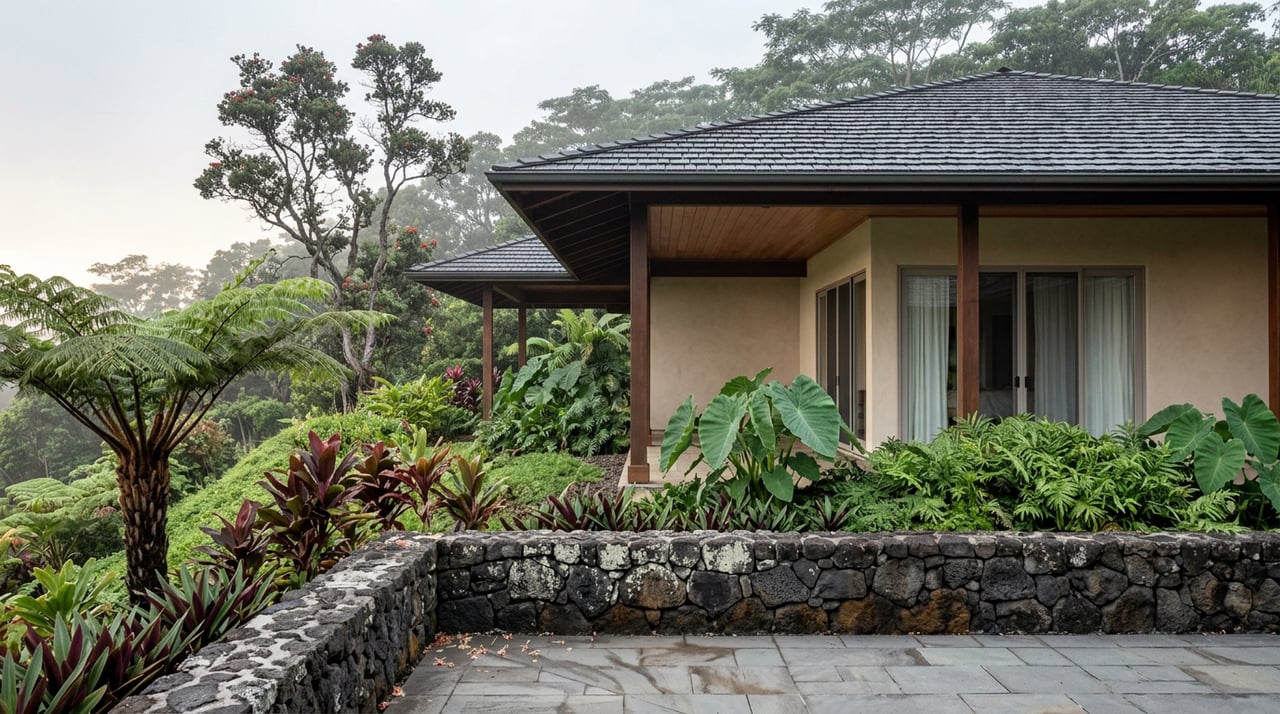
A buyer's agent pulls comps for a three-bedroom on a half-acre in Captain Cook and finds two closed sales that look like twins on paper. Same square footage, same year built, same distance to Highway 11. One sold for $560,000. The other sold for $890,000. Nothing on either listing sheet explains the gap, because the thing that explains it never made it onto either sheet: one house sits on the Hawaii County water grid, and the other depends entirely on the rain that lands on its roof.
That is the actual dividing line running through Captain Cook real estate right now, and it has nothing to do with granite counters.
The median everyone quotes doesn't agree with itself
Pull up three different sources tracking Captain Cook home prices in 2026 and you'll get three different stories. As of early July 2026, one Big Island brokerage site tracking active listings put the median list price at $818,000, with homes averaging $606 per square foot and sitting on the market about 107 days. A month later, in August 2026, another national aggregator pegged the median list price at $875,000, with median days on market at 113, actually an 18 percent drop from August 2025, meaning the higher-priced end of the market was moving faster than the year before, not slower. Meanwhile, a third tracker measuring what homes actually closed for, not what sellers asked, put the recent median sale price at $399,500, down 11 percent year over year.
That is not a data error. Those numbers are measuring two different markets that happen to share a census-designated place name. The list-price figures skew toward the coffee-belt estates and gated view lots that sit for months waiting on a buyer willing to pay for acreage and ocean panoramas. The sale-price figure captures what actually moves, which tends to be smaller, off-grid parcels that trade faster because they're priced for what they are: homes with a $12,000 to $40,000 water system baked into their cost of ownership, whether the listing says so or not.
If you're comparing Captain Cook to Kealakekua or Kailua-Kona using a single median number, you're comparing an average of two markets that don't behave the same way.
The line at 1,000 feet
Most of Captain Cook sits between 800 and 2,000 feet above sea level, which is exactly why it grows some of the best coffee in the world. It's also why a meaningful share of the town sits above where the Hawaii County Department of Water Supply's pipes reach. Below a certain elevation, a home connects to the county grid and pays a monthly water bill like anywhere else in America. Above it, in much of the coffee belt that makes Captain Cook what it is, a home catches its own water off the roof, stores it in a tank, and treats it before anyone drinks it.
A three-bedroom home a few minutes' drive from another can sit on two entirely different utility systems, and the listing photos will look identical either way.
This isn't a flaw in the housing stock. Catchment is legal, common, and, according to the company that installs a large share of the tanks in this exact district, works well here because South Kona gets steady, predictable rainfall from trade winds rising up the mountain, roughly 50 to 80 inches a year. The issue for a buyer isn't whether catchment works. It's whether you know which system you're buying into before you write the offer, because the two paths carry very different costs.
What catchment actually costs, once you're past the sticker price
| County Water Connection | Rainwater Catchment System | |
|---|---|---|
| Upfront cost | Connection fee, varies by parcel | $12,000 to $40,000 depending on tank size and site access |
| Recurring cost | Monthly water bill | $800 to $1,800 per year in filtration, testing, and neutralizer upkeep |
| Drought fallback | Not applicable | Trucked water delivery, roughly $300 to $500 per 4,000 to 5,000 gallons |
| Insurance | Standard | Not every carrier writes catchment properties; confirm before you're in escrow |
The math on catchment isn't bad. A household hauling water instead of catching it can spend around $7,000 a year with nothing to show for it afterward, according to the installer's own published cost guide. A catchment system typically pays for itself against that trucked-water baseline within two to four years and then the recurring cost drops close to zero in a normal rain year. The point isn't that catchment is a bad deal. It's that it's a different deal, one with a real upfront number and a real annual number that a buyer comparing a $560,000 catchment home to a $650,000 grid-connected home needs to add back in before the comparison means anything.
Not all catchment water in Captain Cook is the same
Here's the part that surprised me when I dug into it, and it's worth knowing before you assume every catchment tank in South Kona needs the same fix.
Kilauea has been erupting intermittently since December 2024, and the U.S. Geological Survey's Hawaiian Volcano Observatory continues to track episode after episode of lava fountaining at the summit, with the volcano cycling between pauses and new activity through 2026. Sulfur dioxide from that activity mixes with rainfall to create vog, and vog-acidified rain is a real issue for catchment systems on this side of the island. One general guide to Hawaii water catchment lists Captain Cook by name among the zones where tank water routinely tests at pH 4.5 to 5.5, well below the neutral range recommended for drinking water, which means copper plumbing corrosion and the need for an inline calcite or magnesium-oxide neutralizer.
But the same installer's page specific to Captain Cook tells a more particular story: at the 1,000 to 2,000 foot elevation where much of the coffee belt sits, the rainfall arriving up the mountain is described as cleaner orographic precipitation with pH closer to neutral than what shows up further south in Honaunau or down in Pahala. In other words, the general answer for South Kona and the specific answer for upper Captain Cook don't fully agree, and the difference comes down to exactly where on the mountain a given roof sits relative to the vog plume's typical path.
That's not a reason to skip due diligence. It's a reason to ask for the actual pH testing history on the specific tank you're buying rather than assuming based on the town's general reputation. A tank near the highway and a tank a half-mile up the same road can have different water chemistry, and only one of them needs the neutralizer replaced every year.
The other line: septic and cesspool
Water isn't the only infrastructure question tied to elevation and age in this part of the island. Older rural parcels throughout South Kona, including plenty in Captain Cook, were built with cesspools rather than septic systems. Hawaii's Act 125, passed in 2017, requires cesspools statewide to be upgraded or closed, and properties in higher-priority zones can face earlier timelines than the general deadline. For a buyer looking at an older coffee farmhouse or a rural homestead lot, that conversion cost sits alongside the water question as a second line item the listing sheet won't spell out.
What to actually ask before you write an offer
- Is this parcel connected to Hawaii County water, or does it rely on catchment? Ask for the tank size, age, and material.
- If catchment, request the most recent water quality test results, not just an assurance that the system "works fine."
- Ask whether the tank has a working neutralizer installed and when it was last serviced.
- Confirm whether the roof is metal. Catchment systems paired with asphalt shingle roofs are a known red flag for water quality.
- If the property has a cesspool, ask directly about its Act 125 status and get a cost estimate for conversion before you finalize your offer.
- Check with your lender and insurer early. Not every mortgage program or homeowners policy treats catchment properties the same way as grid-connected homes.
FAQ
Is catchment water safe to drink in Captain Cook? With proper filtration, including sediment filters, carbon filtration, and UV treatment, catchment water can meet drinking water standards. The system's condition and maintenance history matter more than the fact that it's catchment at all.
Does vog from Kilauea affect Captain Cook right now? Kilauea has been erupting episodically since December 2024, and USGS continues to issue regular updates on the volcano's status. Whether a given property's catchment water is currently affected depends heavily on its exact elevation and the prevailing wind pattern during recent rain, which is why a recent water test matters more than the town's general reputation.
Does a catchment system affect financing? It can. Some lenders and insurers have specific requirements for catchment or off-grid properties. Confirming this early, before you're deep into an inspection period, saves a lot of stress later.
If you're weighing a coffee-belt property in Captain Cook against something on the grid closer to town, the honest answer is that both can be excellent choices. The number that actually matters isn't the one on the listing sheet. It's the one on the water test and the maintenance log behind it. Brian Axelrod works this exact stretch of South Kona regularly and can walk you through what a specific parcel's water and wastewater setup actually means for your budget before you write an offer. Let's Connect.