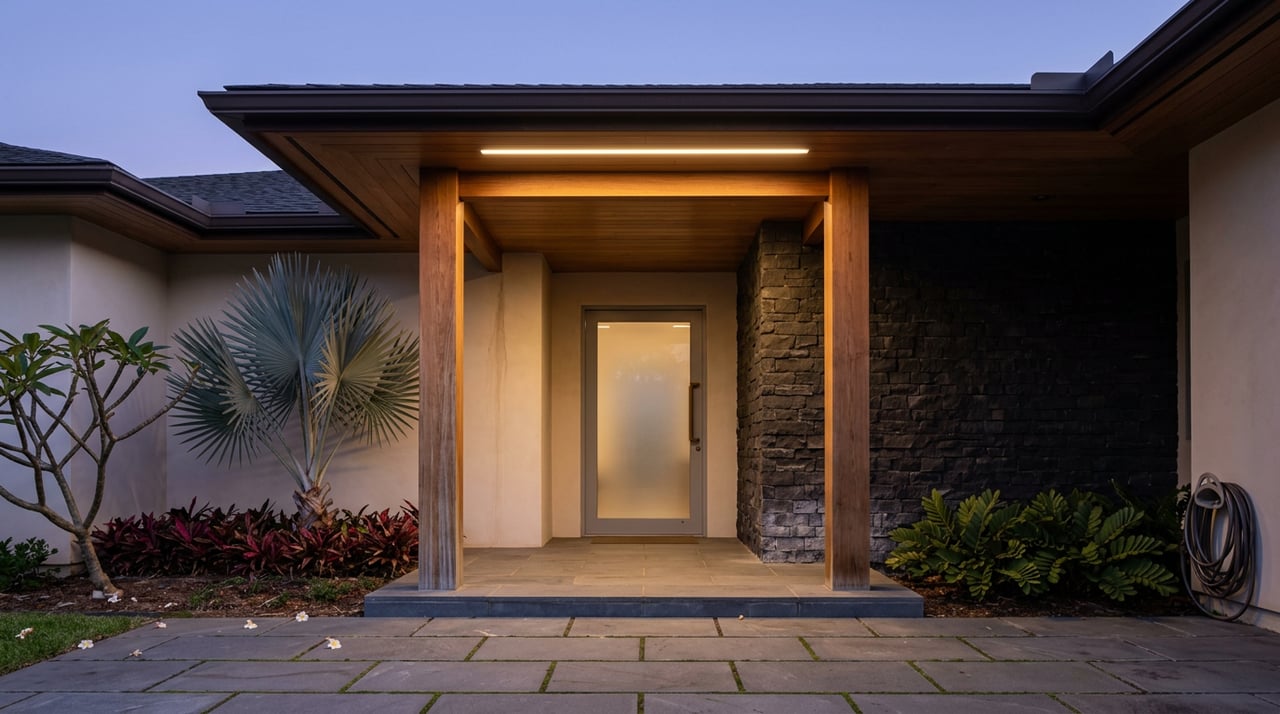
Two homes go up for sale a block apart in Kailua-Kona this fall. Same era, same square footage, same lava-rock retaining walls out front. One sits within a few hundred feet of an existing county sewer main. The other sits just outside it. On paper, both properties are subject to the same statewide rule: convert the cesspool by January 1, 2050. In practice, one seller is looking at a connection fee. The other is looking at a permitted septic system with a leach field excavated through solid basalt, a bill that can run from twenty thousand dollars into the fifties depending on what the ground gives up.
That gap is the story. Not the deadline everyone already knows about. The line.
What actually changed this summer
On July 8, 2026, Governor Josh Green signed House Bill 1618 into law as Act 204. The bill was introduced by Representative Nicole Lowen, a Kona Democrat, and it creates a Cesspool Conversion Revolving Loan Fund inside the Hawai'i Green Infrastructure Authority, offering eligible homeowners low-interest or potentially forgivable loans to help pay for a conversion. West Hawai'i Today's coverage of the signing put the scale of the problem in stark terms: the initial appropriation is two million dollars, seed money against a statewide cost estimate of 2.4 billion dollars to convert all of Hawai'i's roughly 80,000 remaining cesspools if the work were done today.
Read the loan fund as what it is: a real tool, not yet a usable one. The Surfrider Foundation's own tracking of the bill notes the program is still being built out and isn't expected to be operational until summer 2027. If you're closing on a Kailua-Kona property this year, the loan fund is a headline, not a financing option you can write into your contract.
Why Kailua-Kona carries more of this than the statewide average suggests
Cesspools cluster wherever a place grew faster than its sewer infrastructure did. On Hawai'i Island, that means Kailua-Kona itself. Hawai'i County's Department of Environmental Management operates 120 miles of sewer mains, 16 pump stations, and seven treatment facilities across the island, and Kailua-Kona and Hilo remain the only two urbanized areas with a public sewer network at all. Everywhere else on the island, private systems serve resort areas and rural properties handle their own wastewater, cesspool or septic, with no municipal line to fall back on.
That concentration of both cesspools and the one real sewer trunk in the same town is why a longtime Kona-based real estate professional flagged Kailua-Kona directly in legislative testimony on the cesspool mandate. Speaking with the Grassroot Institute of Hawaii, Lance Owens described the state's Priority One risk map as showing a heavy cluster of red dots right in Kailua-Kona, properties the Department of Health considers highest-risk, many of which sit close enough to existing sewer infrastructure that a connection is physically realistic rather than a septic build from scratch.
That distinction matters for how you read a Priority One designation if you come across one on a property you're considering. It is a risk classification, not a separate legal deadline. As of the most recent legislative session, proposals to move Priority One properties to an earlier mandatory date than 2050 have not become law. Priority tells you the state considers a cesspool higher-risk. It does not, by itself, tell you when you're legally required to act. What actually accelerates the timeline is more specific, and it has nothing to do with a map color.
The renovation trap
Under current Department of Health rules, a cesspool can be required to convert well before 2050 if a property owner changes what flows into it. Adding a bedroom, a bathroom, or any modification that increases the volume or changes the type of wastewater a cesspool receives triggers the requirement immediately, tied to the building permit itself.
This is the detail that catches buyers off guard in a market like Kailua-Kona, where a meaningful share of inventory is exactly the kind of property a buyer wants to expand. A guest house addition. A primary suite bump-out. An accessory unit. If the base property runs on a cesspool, that renovation plan now includes a wastewater engineering step you didn't budget for. The state requires a licensed engineer to prepare the individual wastewater system application and a licensed contractor to install it, the same permitting rigor as any other life-safety system.
If you're evaluating a Kailua-Kona property with room to grow, the cesspool question isn't abstract. It's a line item in your renovation budget, and it shows up the moment you file for the permit, not in 2050.
What this means when you're negotiating
An appraiser comparing your subject property to recent sales in the same pocket of Kailua-Kona will notice if a neighboring comp has already completed a conversion and yours hasn't. That gap can show up as a downward adjustment, because the appraiser is pricing in a known future expense the other property no longer carries. Buyers have caught on to this too. A cesspool on a property you're purchasing is increasingly something to raise during due diligence, not something to discover after close.
Three questions worth asking before you write an offer, or before you list:
- Is this property inside the existing county sewer service boundary, or would a conversion mean a full septic system with excavation?
- Has the seller had any building permit activity that would have already triggered a mandatory upgrade, regardless of what year it is?
- Has a neighboring property in the same subdivision already converted, and if so, has that shown up in recent comparable sales?
None of these questions require a lawyer to ask. They require knowing which questions Kailua-Kona's specific geography makes worth asking, which is different from the questions a buyer in Waimea or Volcano would need answered.
FAQ
Does a Priority One designation mean I have to convert sooner than 2050? Not currently. Priority level reflects environmental and public health risk as mapped by the state, but as of this year it does not create a separate legal deadline ahead of the 2050 mandate. The exceptions are specific triggers like a qualifying renovation, not the priority label itself.
Can I use the new state loan fund to help pay for a conversion on a home I'm buying now? Not yet. Act 204 was signed in July 2026, but the program it creates is still being developed and isn't expected to be ready for applicants until summer 2027. Anyone converting a cesspool before then is financing it through existing means, including the state's cesspool income tax credit history or private financing.
If I'm buying a Kailua-Kona property with a cesspool, do I have to convert it right away? No. Sellers aren't currently required to convert a functioning cesspool simply because the property changes hands. What matters is accurate disclosure of the existing system and a clear-eyed accounting of the future cost, which is exactly the kind of detail worth pricing into an offer rather than discovering later.
Buying or selling in Kailua-Kona means dealing with a market where the same statewide rule plays out differently depending on which side of a sewer line a property happens to sit. That's the kind of detail worth having someone in your corner for before you write the offer, not after. Brian Axelrod works this corridor daily and can walk you through what a specific property's wastewater situation actually means for your budget and your timeline. Let's Connect.