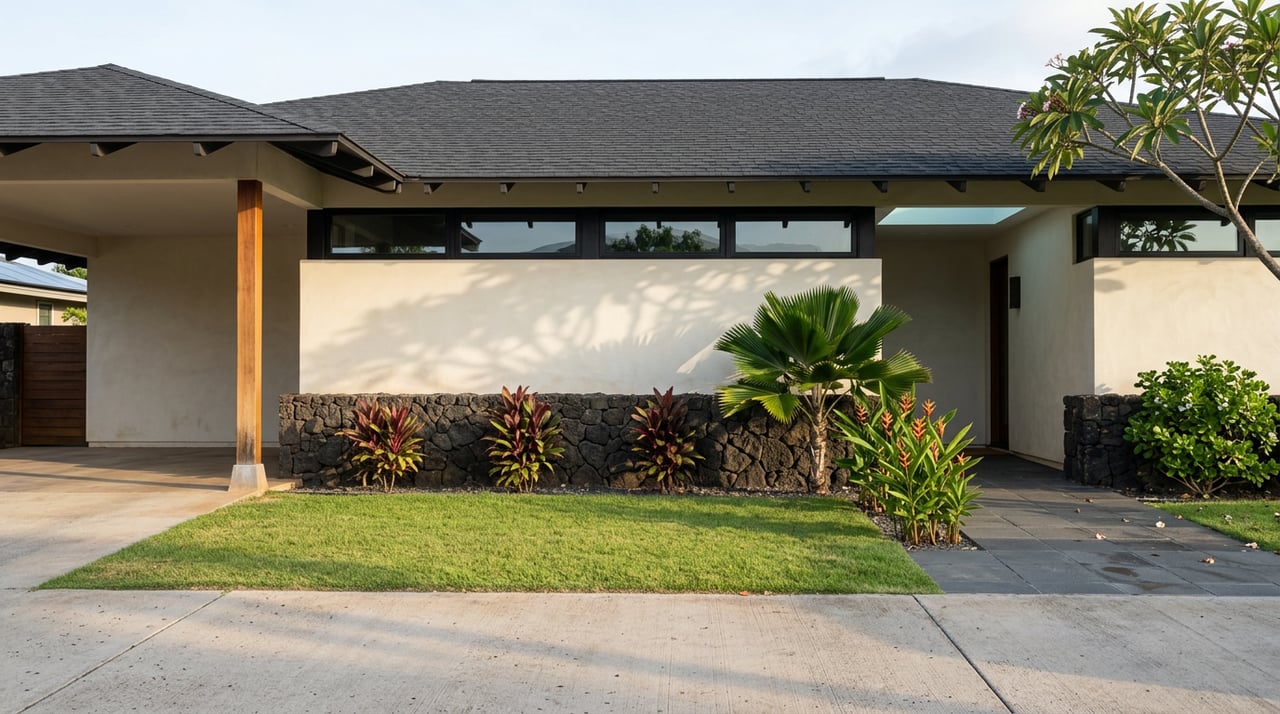
Two listings cross your desk on the same afternoon. Both say Kailua-Kona. Both are priced around $675,000. One is a three-bedroom home in Kaloko Mauka, an established, view-oriented neighborhood. The other is a one-bedroom condo a few blocks off Ali'i Drive, walking distance to the pier.
On paper, they look like the same market. They are not. One of these properties can legally host a paying guest for three nights next week. The other cannot, and under current Hawaii County code, probably never will. That difference has nothing to do with square footage, finish level, or view quality. It comes down to a zoning line most buyers never think to ask about, and it is the reason the "Kailua-Kona median price" you see quoted anywhere online is measuring two markets that happen to share a mailing address.
The numbers already disagree with each other
Pull up three different sources on Kailua-Kona home prices in the same recent window and you will get three different answers. A list-price snapshot from May 2026 puts the median list price at about $950,000. A trailing twelve-month view lands near $1.13 million. A year-to-date single-family figure from mid-2026 runs to $1.225 million. These are not typos or bad data. They are measuring different slices of the same geography at the same time, and the spread between them is the story.
Some of that gap is just methodology. List-price snapshots versus trailing twelve-month or year-to-date figures. Single-family homes counted separately from condos, or blended together. But underneath the methodology sits something more useful for a buyer to understand: Kailua-Kona is not one housing market with noisy reporting. It is two markets with different underlying economics, and any single median is a weighted average of both.
The split shows up clearly once you separate the two
A mid-2026 market report covering the first half of the year breaks the two segments apart, and the divergence is sharp. Single-family homes carried a year-to-date median of $1.225 million, down 6.1 percent from a year earlier. But the median price per square foot on those same homes was down only about 1 percent, which tells you the dollar-per-square-foot value of single-family housing has barely moved even as the headline median slid. Inventory sits at 5.4 months of supply, close to a balanced market.
Condos tell a different story. The year-to-date median fell to $570,000, down 12.3 percent year over year, pulling prices back to levels last seen in 2023 after a run-up that had pushed the median near $694,000 in April 2025. Months of supply on condos runs to 7.7, comfortably in buyer's market territory. That same report points to two forces behind the softer condo numbers: rising insurance costs and tightening rental zoning enforcement.
That second point is the one worth sitting with, because it is not a vague market mood. It is a specific, documented regulatory shift, and it explains why the two segments are pulling apart rather than moving together.
Zoning is the real dividing line, not the neighborhood name
Hawaii County has regulated short-term vacation rentals since 2018 under what's known as Bill 108, formally Ordinance 2018-114. The rule is straightforward in structure even if it is not always straightforward in practice: transient rentals are permitted as a matter of right in Resort-zoned, hotel, and certain commercial or multifamily districts. In residential single-family and agricultural zones, new short-term rentals are generally prohibited unless a property holds a grandfathered Nonconforming Use Certificate from before the ordinance took effect. The county's own short-term vacation rental guidance lays out exactly which zoning districts qualify.
The county spent 2024 and much of 2025 debating a broader package, Bills 121, 122, and 123, that would have created a new framework for hosted rentals and adjusted the rules further. That package stalled. In its place, the county passed Bill 47, later extended by Bill 98, which requires every short-term rental operator, hosted or unhosted, to register with the county. That registration requirement took effect July 1, 2026, with initial fees running $250 to $500 depending on category and fines reaching $10,000 for operating unregistered. Council members have continued refining enforcement tools since, as reported by West Hawaii Today in its coverage of the measure's progress this spring.
Layer onto that a state tax change: the Hawaii Department of Taxation says the transient accommodations tax rose 0.75 percentage points to 11 percent at the state level starting January 1, 2026, part of a new statewide lodging fee. Awning estimates that, combined with the general excise tax and county surcharge, an unhosted rental in a qualifying zone now carries something like an 18 to 19 percent tax load on gross revenue before insurance, management fees, or HOA dues.
None of that touches the owner-occupant buying a single-family home in a residential zone. It touches, directly and specifically, the condo buyer who assumed the unit would carry itself as a rental. That is the mechanism behind the divergence in the numbers above. It is not that condos are simply less desirable. It is that a meaningful share of condo inventory was priced, financed, and marketed around rental income that now carries more cost and more compliance risk than it did two years ago, while single-family homes in residential zones were never part of that calculation to begin with.
What your budget actually buys, by zoning reality
| Price band | Typical location | Zoning reality |
|---|---|---|
| $650,000 to $850,000 | Kaloko Mauka, Kailua View Estates | Residential single-family zoning. Owner-occupant or long-term rental only. No path to nightly rental without a rare grandfathered certificate. |
| $1 million to $2.5 million | Holualoa coffee country, Keauhou corridor | Mixed. Some Keauhou resort-node properties sit in Resort or commercial-adjacent zoning eligible for registered short-term rental. Holualoa is largely residential and agricultural. |
| $3 million to $8 million, up to $10 million-plus for the largest compounds | Ali'i Drive and South Kona oceanfront | Predominantly Resort-zoned or resort-node. This is where legal short-term rental operation is most straightforward, and where the new registration and tax rules apply most directly. |
The practical takeaway is that "Kailua-Kona" spans a residential owner-occupant market and a resort-adjacent income-property market inside the same nine-mile stretch of coastline, and the zoning line between them matters more to your eventual use of the property than the school district, the view, or the finish level of the kitchen.
The village itself is a moving target
Even within the resort-eligible corridor, the ground shifts. Hawaii County ran a 90-day pilot in 2025 converting part of Ali'i Drive to one-way traffic, aimed at freeing up parking along the village's busiest stretch, where paid parking has run $12 to $21 an hour. That kind of access change affects foot traffic in front of the restaurants and shops that make a walkable oceanfront unit valuable in the first place, and it is exactly the sort of detail that doesn't show up in a portal's price-per-square-foot calculation.
The corridor is still investing in itself despite that friction. Big Island Now reported in April 2026 that a group of longtime Kona restaurateurs formed the newly organized Island Restaurant Group and purchased a package of established Ali'i Drive eateries, including the Kona Canoe Club, a longtime waterfront spot once owned by former Los Angeles Dodgers pitcher Don Drysdale, which the new ownership plans to reposition around Polynesian-inspired small plates. A corridor that attracts that kind of reinvestment after a quiet post-pandemic stretch is not a corridor in decline. It is one still figuring out its footing, which matters if you are buying into its long-term rental economics rather than just its view.
What to ask before you compare two listings
Before treating two Kailua-Kona properties as comparable because they carry similar price tags, ask for the zoning district and TMK, confirm whether the property holds an active STVR registration or Nonconforming Use Certificate if rental income matters to your decision, and separate the single-family comps from the condo comps entirely when you're building a mental sense of "the market." They are not the same market, and pricing them as if they were is how buyers end up disappointed at the appraisal or the rental pro forma stage rather than at closing, which is worse, because by then the offer is already in.
FAQ
Is Kailua-Kona a buyer's market or a seller's market right now? It depends which half you're in. Single-family homes sit near balanced conditions with about 5.4 months of supply as of mid-2026. Condos sit more clearly in buyer's market territory at roughly 7.7 months of supply, with prices down double digits year over year.
If I buy a Kailua-Kona condo, can I assume I can rent it nightly? Not automatically. Under Bill 108, unhosted short-term rentals are generally limited to Resort-zoned and certain commercial or multifamily districts, and as of July 1, 2026, every operator must register with the county regardless of zone. Confirm the parcel's zoning and any existing registration before assuming rental income is part of the deal.
Why do different sources quote such different median prices for the same area? Because they're measuring different things: some blend condos and single-family homes, some use list price instead of sale price, and reporting windows range from three months to a full trailing year. None of them are wrong. They're just answering slightly different questions, which is exactly why a single headline number isn't enough to shop on.
Buying in Kailua-Kona means buying into a specific zoning reality as much as a specific address. If you want a clear read on which segment a property actually belongs to and what that means for your plans, Brian Axelrod can walk you through it. Let's Connect.
This article is general information, not legal, tax or financial advice. Consult a qualified professional about your situation.